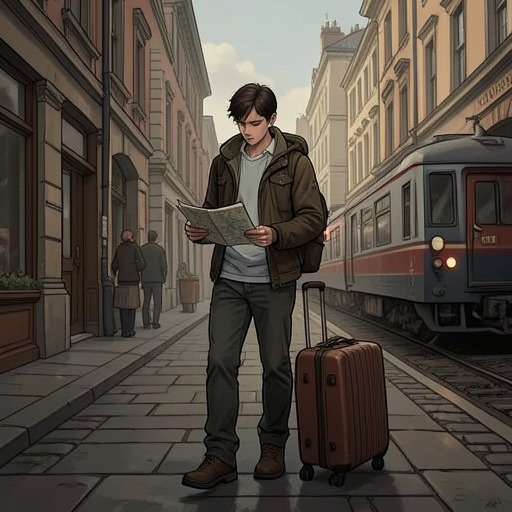
Wellsington Interchange
The Curious Incident of the Dog in the Night-TimeWillesden Junction is the London station where Christopher’s train journey from Swindon ends, but arrival does not end the journey. It is the point at which a route he has prepared through timetables and signs gives way to an unfamiliar street map, a request for help, and a walk through a city that overwhelms his senses. The station is therefore both a successful destination and a threshold: Christopher reaches it by following rules, then must construct the next route for himself.
Place in the Journey
Before setting out, Christopher reasons that travelling by train is possible because he understands the basic sequence: consult a timetable, go to the station, buy a ticket, check the departure board, find the platform, and board. His model comes partly from his train set, but also from the real railway network; he remembers Swindon as a place where Sherlock Holmes and Dr. Watson stop for lunch in a story. The station-to-station journey offers a concrete procedure for the larger and more frightening decision to go to London to live with Mother.
That procedure does not make the journey easy. At Swindon station, the tunnel is crowded and echoing, smells of toilets and cigarettes, and seems to Christopher like a cliff edge. He holds a sign for support, covers his ears to think, and eventually finds a corner table where he can close his eyes. There he feeds Toby two pellets of rat food, grips his Swiss Army knife, and works a maths problem to clear his mind. These specific acts of managing noise, movement, and uncertainty prepare the contrast with Willesden Junction: reaching London is an achievement, but the station and its surroundings still require careful coping.
Route-Finding and Arrival
On the Underground, Christopher makes each decision by interpreting the available signs and turning them into a rule. He chooses Willesden Junction on the Bakerloo Line because the Jubilee Line the woman recommended is not shown on the sign he can find. He reads the station list, follows the left-hand tunnel, and chooses the northbound platform because Willesden appears in the upper half of the map and north is at the top. In the crowded passages and on the escalator, he keeps to the side when possible and restrains himself from striking people who stand too close, remembering the police caution.
Christopher times the intervals between stations and notices that each is a multiple of fifteen seconds. When the train stops at Willesden Junction, he steps out and watches the doors close as the train leaves. The other passengers walk upstairs and over a bridge; Christopher remains behind. The station has become quiet enough for him to see only two other people: a drunken man singing indistinctly and an Indian man at a small shop window. Tired and hungry, Christopher does not want to speak to either stranger, since he regards repeated contact with strangers as increasing the risk of something bad happening. But he does not know how to reach 451c Chapter Road, so the practical need for directions outweighs that reluctance.
The Atlas and the Next Route
Christopher asks the shopkeeper for the address. The man hands him a book and says, “Two ninety-five.” Christopher first has to work out that this means £2.95, then pays and sits on the floor against a wall to study the purchase. The LONDON AZ Street Atlas divides London into a grid: a key gives page numbers for the larger-scale maps, and Christopher understands the book as one large map cut into sections so that it can be made into a book. He likes the order this arrangement creates.
Finding Willesden on pages 42 and 43 is not enough, because Willesden Junction is not on those pages. Christopher locates the station on page 58, directly below and joined to page 42 in the index grid, then searches outwards in a spiral with his finger. The map changes the problem from an unbounded city into connected pieces that can be inspected in sequence. Its usefulness is practical as well as reassuring: after identifying the roads between Willesden Junction and Chapter Road, Christopher can set out on a specific route.
From Station to Street
After going upstairs, crossing the bridge, and passing through the grey gate, Christopher finds himself outside in the dark. There are bright lights, a bus, and a large yellow railway sign; because he has not been outside for a long time, the scene makes him feel sick. He narrows his eyes and concentrates on the shapes of the roads, recognizing Station Approach and Oak Lane as the streets he needs to follow. The transition from underground transport to the open street is thus not a simple release from confinement: it brings a different set of visual demands, which he handles by focusing on the map’s road shapes.
Christopher reaches 451c Chapter Road in twenty-seven minutes, but no one answers when he presses the button marked Flat C. The station’s role in his journey ends without delivering him directly to the person he is seeking; it has provided the connection, not the reunion. In the account of the walk, he singles out eight men dressed as Vikings, shouting in costume, and distinguishes them from historical Vikings, who lived nearly 2,000 years ago. He also has to relieve himself in an alley beside the closed Burdett Motors garage because he does not want to wet himself again. Arrival at the address is therefore another completed leg rather than a final resolution.
Narrative Significance
Willesden Junction makes transport infrastructure visible as a sequence of usable and unusable instructions. Timetables, signs, ticket machines, gates, platform directions, and maps connect places, but Christopher can move through that network only by reading its details and breaking decisions into manageable steps. When one sign fails to confirm the recommended line, he chooses another route; when the station itself does not tell him how to reach the address, he buys an atlas and works out the connection page by page.
The station also concentrates the contrast between objective connection and lived accessibility. Willesden Junction is on the railway, and Christopher successfully reaches it, yet the crowded public spaces, the need to approach a stranger, and the unfamiliar street beyond the gates remain obstacles. His progress depends not on a sudden mastery of London but on learned routines, exact observation, and the willingness to ask for help when his own map is incomplete. As a place in the journey, Willesden Junction is a hinge between the ordered world of routes and the uncertain work of finding a home.